Remote Sensing · Australia · 20m

Annual fuel mapping
for fire-ready
landscapes

High-resolution fuel hazard, fuel load, fuel type and forest structure datasets derived from satellite and airborne remote sensing — updated annually across Australia.

20m
Resolution
9 yrs
Time series
15+
Metrics
4
Catalogs
fuelmaps.flarewildfire.app
Catalog
Fuel Hazard
Metric
Overall FH
Year
2024
Overall Fuel Hazard
LowExtreme

Four catalogs,
one platform

Each catalog is derived from multi-source remote sensing and calibrated against field observations, delivering operationally-ready inputs for fire behaviour modelling and land management.

01 — Fuel Hazard

Fire Hazard
Classification

Six-layer hazard assessment aligned with the DSE Overall Fuel Hazard Assessment Guide (Report 82). Rated 1–5 Low to Extreme, covering bark, elevated, near-surface and surface fuel strata.

Overall FH Surface Near-Surface Elevated Bark Combined
02 — Fuel Load

Aboveground
Biomass Density

Total dry mass of living vegetation derived from NASA's GEDI spaceborne LiDAR Level 4A product. Expressed in tonnes per hectare, calibrated for Australian vegetation communities.

GEDI L4A t/ha 0–500 t/ha
03 — Fuel Type

Bushfire Fuel
Classification

Discrete vegetation fuel type mapping using the NBIC ACS Stage 2 scheme. 40+ classes spanning closed forests, plantations, woodlands, shrublands, grasslands and WUI zones.

NBIC ACS Stage 2 40+ classes WUI zones
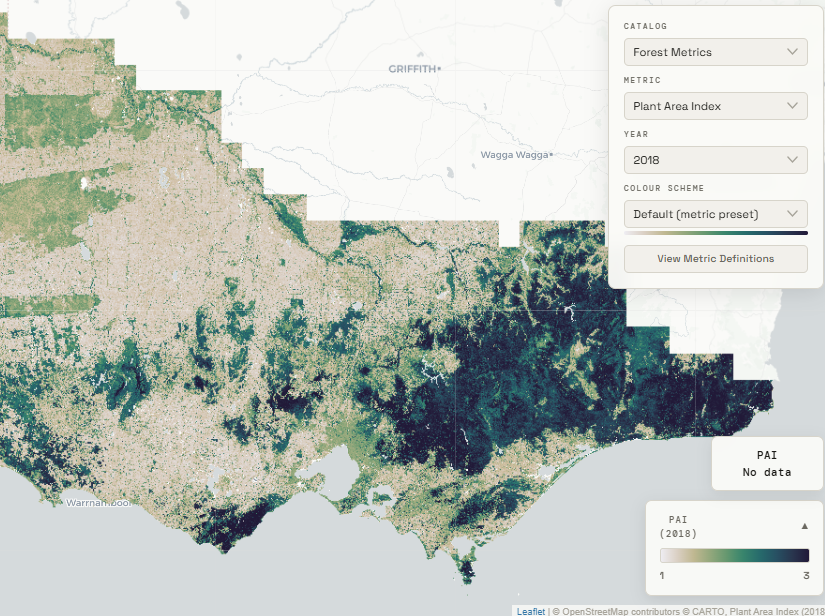
04 — Forest Metrics

Forest Structure
& Extent

Six structural metrics characterising canopy architecture from GEDI and optical fusion — inputs for biodiversity assessments, carbon accounting and fire behaviour stratification.

Canopy height FPC PAI FHD Woody extent
// Methodology

From satellite sensors
to operational maps

01

Multi-source acquisition

Fuses data from spaceborne LiDAR (GEDI), Sentinel and Landsat optical time series, and airborne surveys to capture 3D vegetation structure annually.

02

AlphaEarth embedding

Deep learning foundation models trained on Australian ecosystems extract structural and spectral features, enabling wall-to-wall prediction at 20m resolution.

03

Cloud-optimised delivery

Products are served as Cloud-Optimised GeoTIFFs via TiTiler — enabling fast, browser-based visualisation and direct GIS integration.

Ready to explore your landscape?

Browse fuel hazard, biomass and forest metrics across any region of Australia from 2017–2025.

Open Map →